Sustainability is Shaping the Next Generation of Innovation
Companies in clean energy, agricultural technology, environmental science and life sciences need campuses that reflect their values. Sustainability has risen to the top of those values, quickly becoming a primary criterion in corporate site selection. In Georgia, Rowen embeds sustainability initiatives into every layer of its development to fulfill this evolving need.
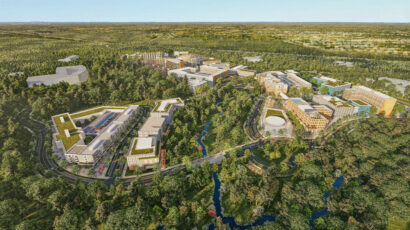
Rowen is a 2,000-acre planned knowledge community just east of Atlanta, designed from the ground up around sustainable development principles. Its nonprofit, foundation-led structure is a structural differentiator. Decisions are made with a long-term, mission-driven orientation focused on long-term economic growth and environmental sustainability, rather than short-term return cycles.
European and international companies prioritizing corporate sustainability will find Rowen to be a strategic partner for expanding into the U.S. market.
What a Sustainable Business Park Actually Looks Like
Other sustainable business parks exist, but most retrofit sustainability onto an existing model. Research Triangle Park, a 7,000-acre research campus founded in 1959, has added sustainability initiatives like a planned transit hub in recent years, layered onto decades-old infrastructure. Great Plains Industrial Park in Kansas holds a genuine carbon-neutral certification, but within a manufacturing and logistics model, the exact heavy industrial uses Rowen’s master plan excludes by design. Rowen’s difference is that its nonprofit governance and exclusion of incompatible uses were built into the plan from the outset, not added after the fact.
Rowen’s campus supports more than 22 million square feet of low, medium, and mixed-use density development across an estimated 30-year build-out. The site explicitly excludes heavy manufacturing, large-format retail, industrial logistics, and distribution, a master plan built around economic sustainability and environmental protection alike. Offices, research facilities, residences, public spaces, and preserved greenspace blend together in a single walkable, connective setting that protects the site’s natural environment for the long term.
The campus’s location along GA-316/University Parkway and its position at the midpoint of the Athens-Atlanta corridor offer a geographic advantage to reduce commutes while supporting regional connectivity. More than 1,900 acres remain available for development, providing a long-term runway for companies.
The Companies and Industries Rowen Is Built For
Sustainable knowledge communities support clean energy and smart city innovation by pairing purpose-built infrastructure — from telecommunications networks to clean-power capacity built around resource efficiency — with research partnerships that give companies a live testing ground rather than conventional office space. Rowen is a powerful choice across multiple industry sectors, notably clean technology, renewable energy, agricultural innovation, environmental science, medicine and life sciences.
Smart city technology is a deliberate part of Rowen’s environmental focus, not a side benefit of its walkable design. Phase one investment in telecommunications infrastructure was built specifically to let future tenants and researchers test in the public right-of-way, and Rowen has supported e-mobility living labs and research on campus as part of that same commitment.
Rowen’s focus on the intersection of medicine, agriculture and the environment creates natural clustering potential. Companies in similar fields become strategic neighbors, benefiting from proximity to each other.
Neighborhood amenities planned throughout the campus will serve the workforce, residents and visitors. This dynamic offering creates a self-sustaining community rather than a conventional office park.
Sustainable Economic Development Rooted in Research
Local and university partnerships advance Rowen’s environmental commitment. Rowen’s Living Lab Platform is a formal partnership structure with the University System of Georgia and the Technical College System of Georgia, enabling students to learn, collaborate and conduct applied research directly on site.
Rowen takes pride in its university partners, such as the University of Georgia (UGA), excelling in agricultural sciences, environmental research, natural resources management, and commercialization programs. These research interests align with Rowen’s environmental and agricultural innovation mission. UGA has also established a new medical school in Athens and hosts the Georgia Network for E-Mobility (GNEM), a research effort Rowen has worked with directly.
Other university partnerships nourish Rowen’s core sectors, including Georgia Tech (biomedical engineering, clean energy and advanced materials), Emory University (health sciences, AI in medicine), Spelman College (biochemistry and environmental science), and Georgia Gwinnett College, whose School of Science and Technology is engaged in Rowen’s e-mobility living lab alongside its broader health sciences and biology programs.
This Living Lab structure means sustainability research conducted at Rowen has a direct pathway from discovery to application, which office parks and business campuses can’t replicate.

Green Technology Innovation Starts with the Right Infrastructure
Rowen is site-ready and provides utilities, transportation access, and scalable infrastructure that support the operational demands of clean manufacturing and R&D, while preserving renewable resources like forested land and open water systems that support long-term biodiversity on site. Ample investments across nearly a quarter of the 2,000-acre site have set in place water, sewer, and transportation services. Rowen has a dedicated power substation and direct gas service with a pipeline on site.
Companies investing in Rowen benefit from convenient access to Hartsfield-Jackson International Airport and the Port of Savannah, offering strategic advantages for supply chain and distribution requirements. An inland port in nearby Gainesville is just 35 miles north of the site. Companies in need of freight access can tap into the CSX rail on the campus’s north end.
Gwinnett County’s $174 million infrastructure and incentive commitment tied to UCB’s campus selection underscore public-sector alignment with Rowen’s vision.
UCB’s $2 Billion Campus Signals What’s Possible
When UCB chose Rowen for its new U.S. site, it reinforced market confidence in the campus. UCB’s U.S. headquarters has already called Georgia home for more than three decades, making this its largest capital commitment yet to a campus built explicitly around clean, knowledge-based innovation. More than a recruitment win, it validates that a purpose-built, sustainability-oriented campus can attract global-scale biopharma investment.
Rowen’s clean innovation mission aligns with UCB’s publicly stated green priorities, including an SBTi-validated goal to cut greenhouse gas emissions 90% by 2045, and its broader sustainability commitments. UCB cited Rowen’s collaborative environment and long-term life sciences vision as key factors in its site selection.
Why Sustainable Companies Are Choosing Rowen
It all comes down to design and governance, research infrastructure and site readiness.
Rowen’s flexible master plan embraces sustainability in meaningful ways, guided by its nonprofit governance model. Formal research partnerships with Georgia’s leading universities drive its mission forward through the Living Lab Platform. A board composed of business and academic leaders understand the industries Rowen is seeking. And its site-ready infrastructure with public-sector backing and regional logistics access make it an obvious win for companies who want to hit the ground running.
Rowen is both a model and a partner. Companies that locate to Rowen are not just accessing a campus, they are joining an ecosystem built to advance the same goals they are working to achieve.
Companies in clean tech, agricultural innovation, environmental science and life sciences know exactly what they need, and Rowen offers a strategic partner for advancing broader sustainable development goals in the communities where they operate. Learn more about the benefits by connecting with Rowen directly.
 Blog
Blog
Sustainability is Shaping the Next Generation of Innovation
Companies in clean energy, agricultural technology, environmental science and life sciences need campuses that reflect their values. Sustainability has risen to the top of those values, quickly becoming a primary criterion in corporate site selection. In Georgia, Rowen embeds sustainability initiatives into every layer of its development to fulfill this evolving need. Rowen is a 2,000-acre planned knowledge community just east of Atlanta, designed from […]
 Media Coverage
Georgia invests $1B to turn Route 316 into ‘workforce expressway’ between Atlanta and Athens
Originally posted in Atlanta Business Chronicle. A decade from now, a series of stop-and-start intersections along the state highway connecting Atlanta to Athens will be ditched in an effort to improve traffic flow and accommodate growth. Georgia’s Department of Transportation is investing approximately $1 billion into a long-term overhaul of state Route 316. The four-lane […]
 Announcements
Rowen Foundation Announces Leadership Transition
The Rowen Foundation today announced that President and CEO Mason Ailstock will step down after accepting a new opportunity. The Rowen Board of Directors is conducting a national search for Rowen's next president and CEO with the Board anticipating new leadership later this fall.